IamCraig.com Rotating Header Image

english

My brief submission to Ian Hanomansing’s “Cross Country Checkup” on CBC Radio

Ian Hanomansing’s first topic in his weekly radio show on CBC was, “Is Canada more like Europe than the United States? What’s at stake for you if Canada builds closer relations with the EU?”

I wasn’t going to wait on hold for half the day, so I used their submission form at https://www.cbc.ca/aircheck to submit my (unused) thoughts. Of course, I found out that there’s a length limit; not that my thoughts were millions of pages in length, but apparently 600 characters (not words) are long enough.

This is what I wrote:

I am an immigrant to Canada. I came here from southern Africa, a former British colony, 45+ years ago.

My simple answer to your question is that Canada is currently more like the United States. Unlike Australia, for example, which is more like Europe — the United Kingdom specifically — than the United States.

I don’t think what Europe is suggesting is full membership, hence the word associate, so talk about Brexit isn’t really relevant. I’m a dual Canadian/European citizen, so I don’t feel that there is anything “at stake” for me, but I feel closer to Europe, even though I’m just a few kilometres from the US border. And even though I’ve had a mail box in Blaine for years (which expired this year), I have refused to cross the border since 2025.

That’s 754 characters, but I deleted the last sentence to get in what little I could. I won’t bother making that mistake again; some people have ridiculous length limits on submissions.

To expand somewhat, because this is my own goddam blog and there are no length limits, I grew up in a former British colony, and I don’t apologise for using something closer to British English. I have no strong opinions on whether British English is the “correct” English, but it is my preference, just as many people have decided that the American version of the language is their preference. I know the American version is supposedly newer and makes more sense (to some people), but my personal opinion (if you’ll excuse my redundancy) is that it is lazy, and I don’t like lazy. This is especially true in Canada, where we’re right next to the States and 99% of the population just accepts the fact that the default in many computer programmes in multiple operating systems is to use American spelling, and so they will swear up and down that the correct spelling of “colour” is “color”, because they simply don’t know the difference. And that’s part of the reason why I hold that Canada is more like the United States.

And what’s “at stake” for me? I don’t think there’s really anything “at stake” for me. I like the fact that I am a dual citizen; I think of a few of my friends with even more than two citizenships and I am jealous. (I no longer qualify for citizenship in my country of birth, because I’m the wrong race.) I live in the 21st century where one’s citizenship isn’t primarily a statement about your loyalty; it’s just a piece of paper that one (or more) governments have decided to give you, and which entitles (or obligates) you to accept some rights or responsibilities. And if you don’t like some of those responsibilities, you can reject that citizenship. That’s a choice that most of the population doesn’t have, and so I realise I am privileged.

But this question is not about dual citizenship, but I still think that nothing is “at stake” for me. My business is international anyway, and it has nothing to do (directly) with my citizenship. If I really wanted to do business in the EU, I suppose I would research this supposed “associate membership” more and see how it could benefit me, but I don’t see how it would benefit me. Like 99% of any special offers you see on TV, it does nothing for me, and everything for whoever is pushing the offer on me. Thanks, but no thanks.

So there’s my answer in 2303 more characters. That’s all of 3.8 times as many as the 600 characters I was allowed. Phew! I’m exhausted.

Zed versus zee

I have to admit that I mostly complain on this blog. It’s like the old cliché, where the news only reports on the bad things that happened that day, because everything else is unremarkable … right?

But speaking of the news, today, here in Canada, I was watching the Global National news, and the teleprompter reader (Carolyn Jarvis) actually referred to “gen-zedders” and not “gen-zee’ers”! Most Canadians are so brainwashed by American culture that they use the latter — “zee” instead of “zed” — when referring to the last letter of the alphabet. I was so shocked that I texted a friend! 🙂

It’s nice to hear that not all Canadians are brainwashed. Now that is remarkable!


Updated, 2025-02-08: This didn’t last long. A couple of months later someone on Global News BC referred to “gen zee”. 🙁

Hard to take the Aussie Pie Guy (or Resourcecode Media Inc.) seriously

In Vancouver there is a company called Aussie Pie Guy. I have to admit, I like their pies. I haven’t tried them all, but the Trifecta Pie is pretty darn tasty. I recommend them.

But their website makes me want to chunder.

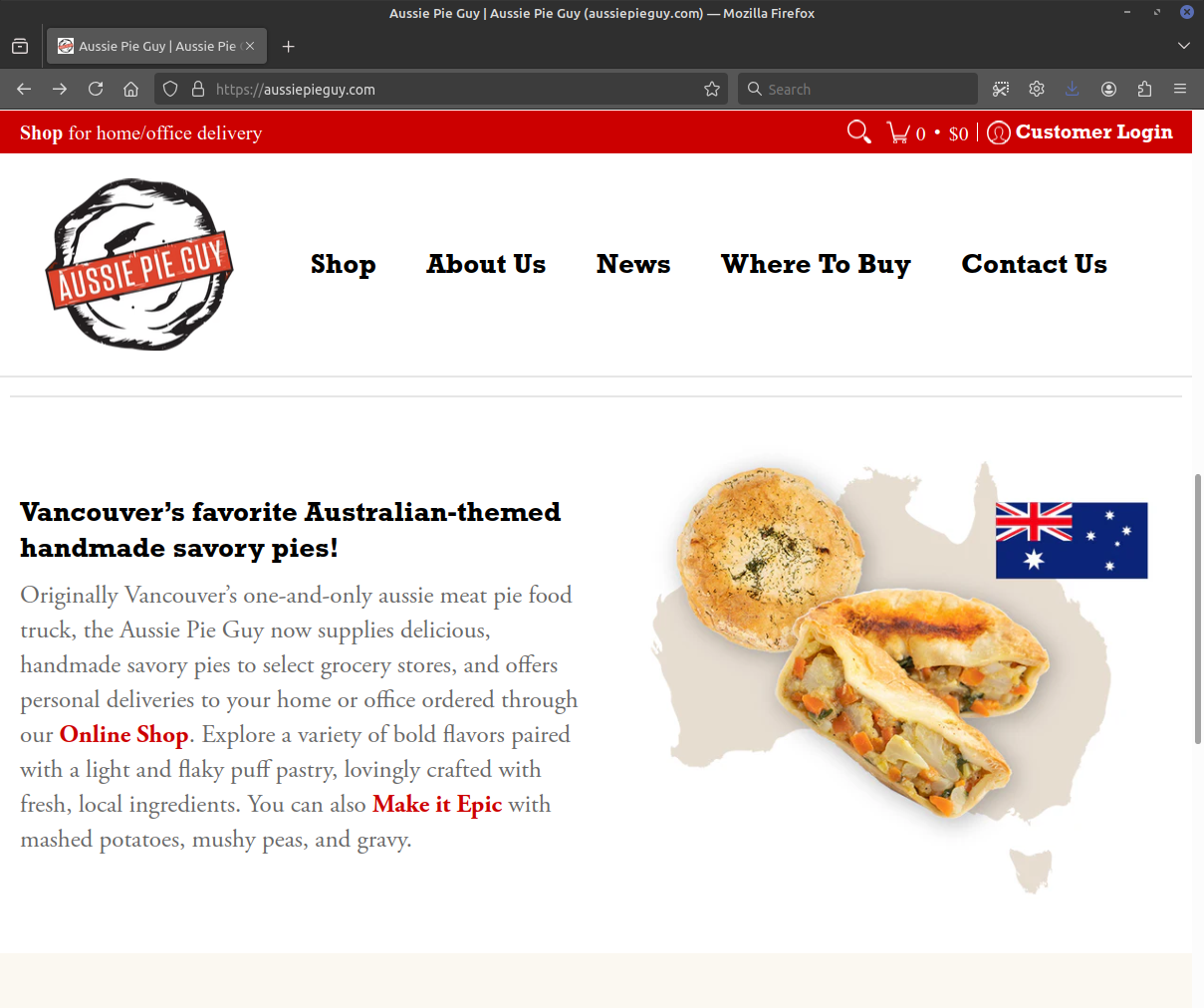
Take a look at the screenshot below. How many spelling mistakes and other errors can you find in the four sentences? By my count there are five!:

  • “favorite” –> favourite
  • “savory” –> savoury (x2)
  • “flavor” –> flavour
  • “aussie” –> Aussie (it’s a proper noun)

They claim to produce “Australian-themed … pies” in Canada, both of which are Commonwealth countries that (for the most part) use British English, not American English! At least the punctuation and grammar are passable. And I’ll give them the capitalisation error; I suppose it looks better from a marketing perspective if the lone word doesn’t clash or cause confusion with the name of their company.

But this website is apparently made by a company that bills themselves with the slogan, “Multi Language Website Design, Development and Translation“! Uh, yeah, sure! I speak French, passably, but I don’t claim that I’m bilingual and market myself as such to paying customers! But if you know my definition of the word “marketing“, you’ll understand.

Aussie Pie Guy website screenshot, 2024-11-16.

Aussie Pie Guy website screenshot, 2024-11-16

Encrapification: My vote for word of the year, even though it’s only February

David Eby

David Eby. (Picture courtesy of BC NDP. CC BY 2.0 Deed. Cropped.)

The frustration of David Eby, premier of British Columbia, was palpable in his “2½-minute tirade” on Thursday (8 February 2024) against BCE Inc., parent company of Bell Media and therefore CTV News and all of its many holdings. But it was his invention of the word “encrapification” that stole the show for me. My web search for the word turned up the above CBC report as the first search result on Friday.

The great thing about the English language is that it is constantly evolving, and that it has building blocks to create words like this. I can’t speak for other languages, of course; I’ve studied several over the years, for which I’m grateful (especially Latin), but besides English there’s only one other (French) that I can say I could speak reasonably well in a pinch, but I don’t know it well enough to invent words in this way.

But Eby is completely right. I used to be all in favour of companies like BCE doing whatever they reasonably could to make more and more money but, as we’ve seen over the years with the likes of Facebook, Google, Microsoft (remember them?!), Amazon, etc., real people are hurt when companies become too big to care about both the people they employ and the people to whom they sell their products and services. I don’t imagine that the CEO of BCE woke up one day and decided to gut the media landscape in Canada, but he has. Eby’s characterisation of what BCE has done reminds me of what Canada Post did on a much smaller scale years ago: When I left college I expected to be quite movious — another great addition to the English language courtesy of Zambian English meaning to move around a lot — and so I rented a post office box. I rented it at the Vancouver International Airport because, working in the aviation business, I expected to be there often and so it would be convenient to be able to collect my mail there when I happened to be at that airport. It was going to become my “permanent” address.

Canada Post had other ideas, of course. They stopped renting new mail boxes at the “Airport Postal Outlet” (as it was known) and then, in a remarkable turns of events that nobody without an MBA could ever have predicted, they then claimed that there was not enough mail going there to support the existence of said outlet! Despite my attempts to “Save the APO“, it was taken away, and thus began my never-ending quest to set up new “permanent addresses”. What a gong show. I have had no fewer than seven “permanent addresses” in thirty-three years, when really, I should have had ONE!

BCE/Bell logos

A few random logos of the involved entities. Trademarks of the respective corporations.

Anyway, back to BCE. The day after Eby made headlines there was another politician who was evidently jealous of the attention that he wasn’t getting, so Justin Trudeau got on the horn (apologies to those of you for whom that phrase has a more lurid meaning!) and called it a “garbage decision” and said he was “pissed off”. Good effort Justin, but not nearly as cool as Eby! 🙂

At least CTV’s newly unemployed former employees will be able to count on Canadians’ thoughts and prayers for a day each year when Bell does their annual “Let’s Talk Day“. Thoughts and prayers certainly helped Lisa LaFlamme a lot when they fired her for letting her hair go grey, just as they helped me when Bell ripped me off for $11.27 for a one-minute phone call!

What is “white fragility”?

I posted the following as a comment on the “What is ‘white fragility’?” article on the Oxford Dictionaries blog, but that was a week or so ago and the moderators have not approved it, so I’ll post it here instead.


TL;DR: You’re damned it you do and damned if you don’t.

The problem with inventing a pejorative, racist phrase like “white fragility” and then defining it as any possible reaction a white person can have to being presented with information that casts his or her race in a negative light in a discussion he or she knows she or he cannot win — including silence and the simple act of “leaving” or not participating in the discussion — is that it’s a blatant attempt at actively marginalising a definable group in a “damned if you do and damned it you don’t” way. So then, you might ask, what’s the point of inventing the phrase and defining it? It’s to be “reverse” racist! So yeah, since I’m white my reaction is yet another “textbook example” of my “white fragility” because any reaction, including clicking the back button and choosing not to engage, is (by definition) “white fragility”! There’s nowhere to hide in this maddening circular argument in which there is no possible way for a white person to save face or even ameliorate the position presented, and it’s designed to pre-emptively cut the legs out from any possible position a white person might take by allowing every non-white person to dismiss their position, no matter how valid, as just another “textbook example” of “white fragility”.

In the “textbook example” given, Captain Scott Arndt is simply ignorant of the statistics and a denier of (I can only assume) valid statistics collected using valid scientific methods. That just makes him an idiot, and idiots come in all hues. He then responded in a typically American fashion, which is to whine and file a complaint over something that could have been resolved in minutes if more mature and intelligent people were involved, and the American media responded in typically American fashion by making a mountain out of a molehill. If the statistics he couldn’t stomach only involved transgender people and not “transgender people (of color)” (one wonders why the author bracketed those words, when they aren’t bracketed anywhere in the media release [not “scholarly data”] to which she links) then this whole “textbook example” of “white fragility” would fall apart! It is not, in fact, a “textbook example” of “white fragility”; it’s a “textbook example” of two police officers who have poor interpersonal skills (and probably other undocumented issues between them) and as much an example of “cisgender fragility” as it is “white fragility”! But the latter doesn’t conveniently feed into the author’s racist narrative.

And let’s not even get into how it should be “politically correct” for people to issue “trigger warnings” to their fragile, white friends to whom they might be about to say something that will trigger “white fragility”! On the one hand political correctness demands that we be super-sensitive to others’ feelings, and on the other just blatantly and gleefully tramples all over my feelings of “white fragility”! Oh the irony!

“Shedule” versus “Skedule”

Having been challenged about this yet again recently and still not having much more to offer than the stunning revelation than that the English language is full of exceptions to rules — because, really, it’s not a surprise or a big deal to me that different people in or from different parts of the world pronounce things differently — I decided to do some research.

The tired old comparison is to the word “school”. “Why don’t you pronounce it ‘shool’?” goes the typical witty refrain. Really? That’s your best argument for why I’m supposedly pronouncing the word “schedule” incorrectly? Why are there two pronunciations and three meanings of the word “desert”? Why ask me? Who died and left me in charge of making the rules of the English language and ensuring that every word conforms without exception?!

Sometimes it amuses me the number of Canadians who simply don’t realise the extent to which they are influenced by American English, even when the closest thing we have to an official guide north of the border — the Gage Canadian Dictionary — goes against American wisdom and sides with British norms. It’s a sad result of our proximity to the States, Hollywood, and American dominance in certain other areas — such as the default settings for spellcheckers in software created by American companies, not the least of which is Microsoft. (Although, maddeningly, my copy of Mozilla Firefox keeps reverting to United States English unbidden!) But distance does not save even the British themselves — and others like South African, Indian and south Pacific speakers of English — from the grubby hands of “Pax Americana”.

You may or may not be aware that the English language contains a vast number of loanwords. According to a couple of impeccable sources (one an answer on the collaborative English Language & Usage “Stack Exchange” addressing a bizarre question about class in the UK, and the other a British blogger living in the US), the British “shed” pronunciation is influenced by either French or German, while the American “sked” pronunciation is influenced by the Greek origin of the word. A slightly more impeccable source is the Shorter Oxford English Dictionary, which lists both pronunciations with a preference for “shedule”, and indicates that the word comes to us from Greek via Latin and French. (No mention of German.) There you have it; foreign influences in our pristine, flawless, rule-bound English language! Who would have thunk it?! (Don’t tell the morons responsible for this nonsense!)

OK, now that you’ve taken in the enormity of the difficulties involved in adopting foreign words into “our” language, learn to accept that there are understandable regional differences in spelling and pronunciation. My background means that I often pronounce and spell words the British way and pepper my speech with Afrikaans loanwords, but put me in the company of people who are from the places where I grew up and they’ll tell me that I have an “American” accent and use “weird” terminology. I can’t win. And actually, I like that. I’m not one who wants to be like the rest of the crowd. I’m almost tempted to use “skedule” in their company!

Speaking of which, in my dim and distant past when I briefly worked towards a career in the aviation industry, I did actually occasionally refer to a “sked”, aviation argot (another loanword pronounced as the original French) for a “scheduled flight”. Referring to one as a “shed” would have just been weird.

Anyway, getting back to the aforementioned Gage Canadian Dictionary, it offers both “skedule” and “shedule” as correct pronunciations of the word, in that order. And in case you’re so unimaginative that “school” is the only comparable word that you can come up with, my Concise Oxford Dictionary lists 86 words that start with “sch”. Some of those are compound words and phrases, but here are a few that are unquestionably pronounced using “sh”: schist, schlep, schlock, schlub, schlump, schmaltz, schmear, schmo, schmooze, schmuck, schnapps (yum!), schnauzer (woof!), schorl and schuss.

Now, how did you learn to pronounce those in shool?

Attention Susan Ormiston!

Maybe nobody at the CBC knows any better, or maybe they’re too afraid to correct you. However, I do and I’m not.

The Queen does not PRO-sess canned fish at a packing plant. She does, however, pro-SESS down The Mall in a pro-SESS-shun.

Look it up. You’re welcome.

There was another odd pronunciation (in addition to at least two instances of the above for which I was within earshot of the TV), but I forget what it was. Additionally, I heard someone else remark on your rather odd pronunciation of “Edinburgh” (and by “odd” I mean odd to someone who lives there, not odd to a North American who might assume it’s pronounced as a German might do so), but I didn’t hear that one myself.

Again, you’re welcome.